دانلو د کتاب تاریخی کوتاه از هرچیزی
دانلو د کتاب صوتی تاریخی کوتاه از هرچیزی
A Short History of Nearly Everything Audio book
free download
برنده چندین جایزه در مسابقات گوناگون
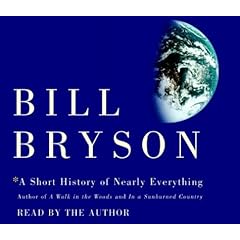
A Short History of Nearly Everything (ISBN 0-7679-0817-1) is a general science book by Bill Bryson, which explains some areas of science in ordinary language. It was the bestselling popular science book of 2005 in the UK, selling over 300,000 copies.[1]
A Short History deviates from Bryson's popular travel book genre, instead describing general sciences such as chemistry, paleontology, astronomy, and particle physics. In it, he explores time from the Big Bang to the discovery of quantum mechanics, via evolution and geology.
Bryson tells the story of science through the stories of the people who made the discoveries, such as Edwin Hubble, Isaac Newton, and Albert Einstein.
|
|
Background
Bill Bryson wrote this book because he was dissatisfied with his scientific knowledge — that was, not much at all. He writes that science was a distant, unexplained subject at school. Textbooks and teachers alike did not ignite the passion for knowledge in him, mainly because they never delved in the whys, hows, and whens.
It was in his later years that he realised with stunning shame that he was ignorant about many things that he wanted to understand. Thus from his own life experience, Bryson discusses topics from an angle involving simple explanations, funny dialogue, interesting facts, and much more.
Contents
Bryson describes graphically how big the universe is, and how small atoms and subatomic particles are. Furthermore, he reports on the likeliness of the Earth being struck by a meteor, how unlikely it is that humans will spot a meteor before it impacts the Earth, and the extensive damage that such an event would cause. He also explores the history of biology, botany, and zoology, and traces life from its first appearance all the way to today's modern humans, placing much emphasis on the development of the modern Homo sapiens. All along the book, humorous stories about the scientists behind the discovery and their half-crazy behaviour is given. Throughout the book, there are many reports on the way humans change the Earth's climate and destroy other species, as well how the Earth was and is a very destructive planet itself, briefly touching about earthquakes, volcanoes, tsunamis, hurricanes, and mass extinctions. His tendency to look for big explosions and awe-inspiring devastation takes him to the most destructive disasters in the history of the world, from Krakatoa to Yellowstone National Park.
Bryson ends the book by noting how many extinctions humans are responsible for, and how lucky mankind is to be living on planet Earth today.
An illustrated edition of the book was released in November 2005.[3]
Awards and reviews
The book received many favourable reviews on its release, although some reviewers have suggested the book contains more than a few inaccuracies, such as where Bryson discusses the number of cells in the human body.[4]
In 2004, this book won Bryson the prestigious Aventis Prize for best general science book.[5] Bryson later donated the GBP£10,000 prize to the Great Ormond Street Hospital children's charity.[6]

RAR'n MP3
Part 1 - Lost In The Cosmos >> 20.2 MB
Part 2 - The Size Of The Earth >> 37.6 MB
Part 3 - A New Age Dawns >> 38.5 MB
Part 4 - Dangerous Planet >> 24.8 MB
Part 5 - Life Its Self >> 96.7 MB
Part 6 - The Road To Us >> 32.2 MB